
There are now five credible ways to get data into Fabric, and the wrong choice costs you for years. An honest comparison of shortcuts, mirroring, pipelines, dataflows and copy jobs, with the matrix we use to decide.
"How do we get this data into Fabric?" used to have one answer. It now has five credible ones, and the choice has consequences that last for years. Pick a pipeline where a shortcut would have done and you have built a copy of the data, a refresh schedule and a failure mode you did not need. Pick a shortcut where a pipeline was needed and you discover at month-end that there was nowhere to put the transformation logic.
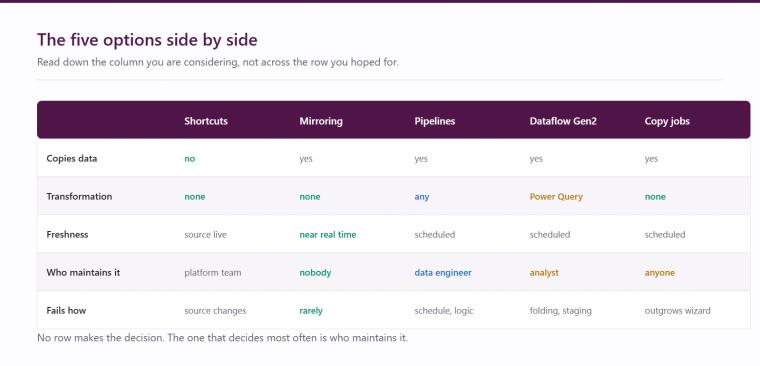
A FabCon Europe 2026 session framed the options neatly on a single slide. This post turns that framework into a decision guide, with honest trade-offs and the scenarios where each option is genuinely right rather than merely possible.
OneLake shortcuts
A shortcut is a reference, not a copy. It points OneLake at data that lives elsewhere, including Azure Data Lake Storage, Amazon S3, Google Cloud Storage and other OneLake locations, and makes it appear in your workspace as though it were local.
- Right when: the data is files or object storage, another team owns it, and you can consume it as it is. Nothing is duplicated, there is no refresh to fail, no second copy to drift, and the source system keeps ownership, which is often exactly what another team wants to hear when you ask for access to their lake.
- Wrong when: the data needs reshaping before anyone can use it. A shortcut is read-only and gives you no transformation layer, and performance depends on a source and file layout you may not control.
Database mirroring
Mirroring gives continuous, near real-time replication from an operational database into OneLake with no pipeline to build. Supported sources include Azure SQL Database, Azure SQL Managed Instance, SQL Server, Cosmos DB and Snowflake, and through Open Mirroring and partner workloads, systems such as Dynamics 365 Business Central. Data is automatically converted to Delta tables and exposed through a read-only SQL analytics endpoint.
- Right when: you want operational data available for analytics with minimal infrastructure. It removes the most failure-prone layer of a data platform, with no watermark logic, no schedule and no gap between what the source holds and what you hold.
- Wrong when: the source is not supported, or you need the ingestion layer itself to transform, filter or combine data. You get operational schema, not an analytical model, so the modelling work still happens downstream.
Data pipelines
Pipelines are the orchestration and movement engine, and the most capable option on this list, which is why they are the most over-used.
- Right when: the work involves more than moving data from A to B. Transformation on the way in, multi-step orchestration with dependencies, error handling and retry logic, metadata-driven incremental loads, or coordination across several sources that must complete in a particular order. Specifically right when you are building the metadata-driven ingestion pattern that keeps a large estate maintainable.
- Wrong when: the only job is copying a table on a timer. A pipeline built where a mirror would have sufficed is a permanent maintenance obligation: a schedule that can fail, logic that needs testing, and a person who needs to understand it.
Dataflow Gen2
Dataflow Gen2 is low-code graphical ETL based on Power Query. Its real strength is who can use it: analysts and business users who know Power Query can build and maintain transformations without a data engineer in the loop, which matters enormously for the long tail of departmental data.
- Right when: transformations should be business-accessible, or Power Query connectivity is the practical route into a source.
- Wrong when: it is a high-volume core pipeline where cost and performance dominate, or the logic must be version controlled and reviewed by engineers.
The architectural detail that trips people up is staging. Dataflow Gen2 uses a staging lakehouse, and that staging layer is what makes computed entities and query folding behave correctly. Turning staging off to make a dataflow feel faster frequently makes the overall solution slower and breaks folding, pushing work back to the client that should have been pushed down to the source.
Copy jobs
Copy jobs are the no-code option for straightforward ingestion. A wizard-driven setup handles source, destination, full or incremental load, and increasingly capabilities such as change data capture, slowly changing dimension handling and audit columns.
- Right when: the requirement genuinely is "move this data there, incrementally, reliably" and no logic is involved.
- Wrong when: it is the default pattern for an estate that will have forty sources. You end up with forty separately configured jobs and no shared standard, and when requirements grow beyond the wizard you migrate the job into a pipeline anyway.
The decision, in four questions
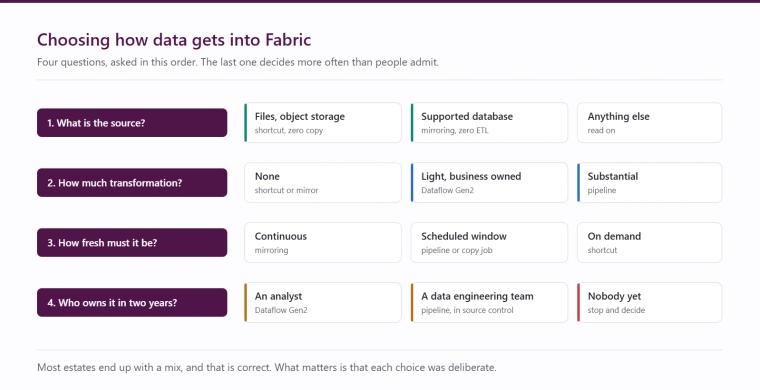
- What is the source? Files and object storage point to shortcuts. Supported operational databases point to mirroring. Anything else points to pipelines, dataflows or copy jobs.
- How much transformation is needed before anyone can use the data? None points to shortcuts or mirroring. Light and business-owned points to Dataflow Gen2. Substantial, or requiring orchestration across sources, points to pipelines.
- How fresh does it need to be? Continuous points to mirroring. Scheduled, with a known window, points to pipelines or copy jobs. On demand, where the source is the system of record, points to shortcuts.
- Who owns it afterwards? If the answer is an analyst, Dataflow Gen2 is likely right even where a pipeline would be technically better. If it is a data engineering team with source control and review, pipelines are right. Choosing an approach nobody present can maintain is the most expensive mistake on this list.
Most real estates end up with a mix, and that is correct rather than a failure of standardisation: mirroring for the ERP, shortcuts to the group data lake, one metadata-driven pipeline for everything bespoke, and dataflows where the business owns the logic. What matters is that each choice was deliberate.
The question behind the question
Teams usually ask us which option is best. The more useful question is which option you can still operate in two years with the people you will actually have. A technically optimal pipeline that one contractor understood is worth less than a slightly less elegant approach the team can maintain, extend and explain to an auditor.
Hopton designs and runs Fabric platforms for mid-market organisations across the UK and Ireland as a Microsoft Solutions Partner. Our Microsoft Fabric and data platform and warehouse pages cover how we approach architecture, and if you are weighing these options on a live estate the free audit gives you an independent view. You can also just talk to us.
Related reading
The pipeline ran is not the same as the data is right: observability for Azure data engineering
ETL, ELT or EtLT: when to transform data in Fabric, and where the rule should live
Microsoft Fabric IQ: Sort Your Definitions First
James Morley
Analytics Solutions Consultant
Part of the Hopton Analytics team, delivering governed analytics programmes for UK mid-market organisations.