Synapse is still supported, but new investment is going into Fabric. What a dedicated SQL pool, serverless pool, Spark pool and pipeline each become, the tools Microsoft provides, the parts that need rewriting, and a realistic timeline.
If you built a data platform on Azure Synapse Analytics between 2020 and 2023, you have a decision in front of you. Synapse is still supported and still running. Microsoft has not announced an end date for it. But new capability is landing in Microsoft Fabric, and the migration tooling Microsoft has built points one way.
This post is for the IT director or data lead who owns a Synapse estate and wants a plain answer to three questions: what does each part become, what is the work, and how long does it take.
What does each part of Synapse become in Fabric?
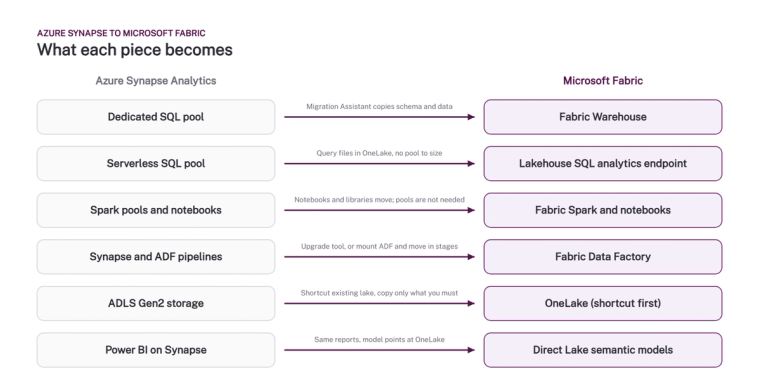
Synapse is five products that share a workspace. Fabric is the same five jobs done on one copy of the data in OneLake. The mapping is cleaner than most migrations.
- Dedicated SQL pool becomes a Fabric Warehouse. The Fabric Migration Assistant for Data Warehouse copies the schema, converts the T-SQL and moves the data with a copy job.
- Serverless SQL pool becomes the SQL analytics endpoint on a Lakehouse. You query the files in OneLake directly, with nothing to size or pause.
- Spark pools and notebooks become Fabric Spark and notebooks. Microsoft documents how to move notebooks, libraries, Spark configurations and the Hive metastore. Pools themselves disappear, because Fabric Spark starts from the capacity.
- Synapse pipelines and Azure Data Factory become Fabric Data Factory. There is a built-in upgrade experience that assesses each pipeline as ready, needs review, coming soon or not compatible, and you can mount an existing Data Factory inside Fabric while you move in stages.
- ADLS Gen2 storage becomes OneLake, usually through a shortcut first. You do not have to copy the lake on day one. Point OneLake at it and move data only where it earns its place.
- Power BI on Synapse becomes Direct Lake semantic models reading OneLake. The reports stay; the model underneath changes.
What has to be rewritten?
Less than you might fear, but not nothing. Microsoft is clear that there is not full T-SQL compatibility between a dedicated SQL pool and a Fabric Warehouse. In practice the items that need attention are:
- SQL authentication. Fabric uses Microsoft Entra ID only, so service accounts with SQL logins need replacing with service principals or workspace identities.
- Data types. money and smallmoney become decimal, datetime becomes datetime2, nvarchar becomes varchar, and datetimeoffset is not supported, so time zone offsets need a separate column.
- Indexes, distribution and partitioning. These are not migrated and are not needed. Fabric manages the physical layout, which removes a whole class of tuning work.
- External tables, multi-statement table-valued functions and column-level encryption. These are not supported as they stand and need redesigning.
- Pipeline features. Mapping Data Flows become Dataflow Gen2 transforms (in preview), linked services become connections, global parameters become a variable library, and triggers become per-pipeline schedules. U-SQL and validation activities need rebuilding.
The Migration Assistant has a fix step for failed T-SQL, with Copilot suggestions. Microsoft rightly says to verify those suggestions before running them. In our experience a dedicated pool with 200 objects produces a few dozen fixes, most of them data types and authentication.
How long does a Synapse to Fabric migration take?
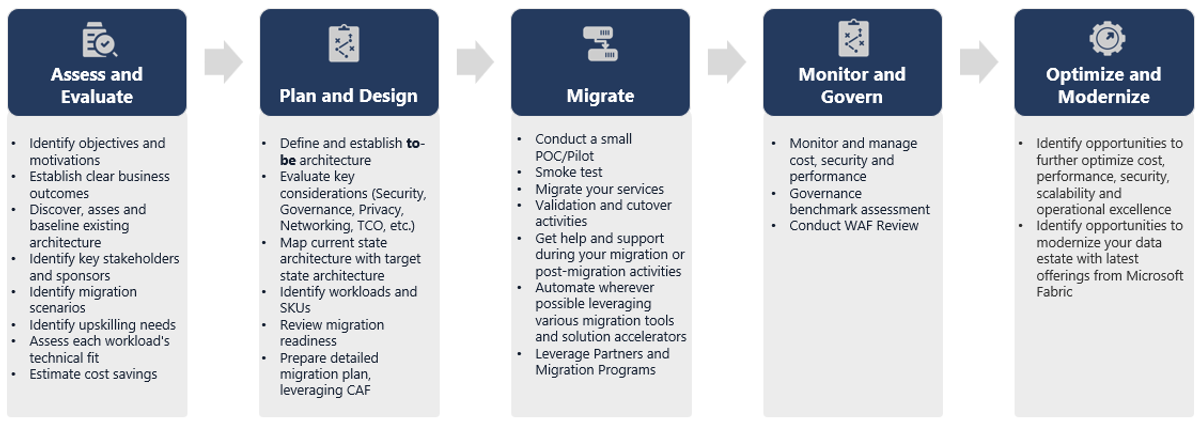
For a mid-market estate, one dedicated pool, a lake, a handful of pipelines and under 30 reports, the realistic range is 8 to 14 weeks, done in three stages that run in parallel for part of the time.
- Weeks 1 to 2: inventory and decisions. Which tables are used, which pipelines still run, which reports anyone opens. This stage usually retires 20% to 30% of the estate before it is moved.
- Weeks 2 to 8: move and fix. Shortcut the lake, run the Migration Assistant, fix the T-SQL, upgrade or rebuild pipelines, repoint the semantic models to Direct Lake. Both platforms run side by side.
- Weeks 8 to 14: reconcile and cut over. Compare every number that matters between the two platforms, switch the reports, then pause Synapse before deleting it.
Larger estates with several pools, heavy Spark and hundreds of reports take longer, and are better moved domain by domain. Our post on planning a data platform migration component by component covers the sequencing.
What does it cost, and what does it save?
Synapse bills you per pool, per hour, whether or not anyone is querying. Fabric bills one capacity for everything, and that capacity can be paused or scaled. Most of the estates we look at run Synapse at a size chosen in 2021 and never revisited. The move is the moment to right-size. Our Fabric pricing checker gives a starting point, and this post sets out UK prices for 2026.
The migration work itself is usually funded by the first year of saved Synapse spend, though that depends entirely on how big the pool was and how much of it was idle.
Should you move now?
Move now if your Synapse estate is due a rebuild anyway, if you are paying for pools that sit idle, or if you want Copilot, Direct Lake or Fabric data agents and cannot have them on Synapse. Wait if the estate is stable, cheap and nobody is asking for anything new. Either way, do the inventory. Knowing what you actually run is the cheapest part of the whole exercise, and it changes the decision more often than you would expect.
If you want a second opinion on your Synapse estate, our free data assessment includes a read of it, or you can talk to us about the move.
Microsoft documents the tooling in Migration planning: Azure Synapse dedicated SQL pools to Fabric Data Warehouse, the Fabric Migration Assistant and Upgrade planning for Azure Data Factory to Fabric Data Factory.
Related reading
- Microsoft Fabric consultancy
- What is a data platform migration, and how is it planned?
- Azure Data Factory vs Fabric Data Factory pipelines: what is different, and which to use
- How much does Microsoft Fabric cost? UK prices for 2026
- What is Microsoft OneLake and how does it work?
James Morley
Analytics Solutions Consultant
Part of the Hopton Analytics team, delivering governed analytics programmes for UK mid-market organisations.