
F2 to F64 in pounds, pay as you go against reserved, Pro licences, overage and storage, then an honest comparison with Databricks and Snowflake.
Microsoft Fabric costs £0.1585 per capacity unit hour in UK South on pay-as-you-go, which makes the smallest capacity, an F2, £231 a month and an F64 £7,405 a month, falling to £138 and £4,404 with a one-year reservation. Add Power BI Pro at £10.80 per author per month, storage at under two pence per gigabyte, and you have the whole bill for most mid-market businesses: somewhere between £5,000 and £60,000 a year depending on the capacity you need. Those are Microsoft's UK list prices as published in the Azure retail price list in October 2026, excluding VAT; they move with exchange rates, so confirm them before you sign. The rest of this post explains what you are paying for, what the hidden lines are, and how the bill compares with Databricks and Snowflake for the same job.
The capacity price list
A capacity is sold as an F SKU, and the number is the capacity units. Every SKU doubles the previous one in both power and price, so the arithmetic is simple: multiply the capacity units by £0.1585 and by 730 hours for pay-as-you-go, or by £825.69 a year for a one-year reservation, which is a 40% discount for committing. A three-year reservation is priced at exactly three times the annual rate, so it buys price certainty rather than a further discount.
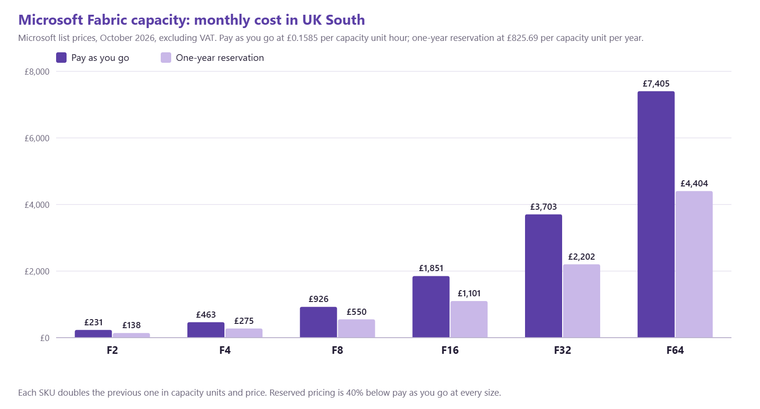
In practice: F2 is £231 pay-as-you-go or £138 reserved; F4 £463 or £275; F8 £926 or £550; F16 £1,851 or £1,101; F32 £3,703 or £2,202; F64 £7,405 or £4,404. Most businesses we work with that run Business Central or a similar ERP alongside two or three other systems sit on an F4 to F16 for a production workload. Our capacity guide explains how to size one and why the number is usually smaller than people expect, because Fabric smooths bursts across a 24 hour window rather than charging for peak.
What else is on the bill
Power BI licences. Anyone who creates or publishes content needs a Power BI Pro licence at £10.80 per user per month, or Premium Per User at £18.50 if they need the paginated and larger model features. Below F64, every report viewer also needs Pro. From F64 upwards, viewers need only a free licence, which is why the break-even for moving to F64 is around 400 viewers on reserved pricing.
Storage. OneLake hot storage is £0.0181 per gigabyte per month, so a terabyte is about £18. Cool and cold tiers are cheaper. Storage is rarely more than a rounding error on a mid-market bill.
Overage. When a capacity is over-used beyond what smoothing can absorb, Fabric throttles rather than bills; the overage meter, at £0.4755 per capacity unit hour, three times the standard rate, applies when you choose to let the capacity run over rather than throttle. Three times the rate is deliberate: it is meant to be a safety valve, not a plan.
On demand. Since FabCon Europe in October 2026, Fabric can also be bought on demand without a reserved SKU, with per-workload meters that run from the standard rate up to three times it. On demand suits development, proofs of concept and irregular workloads; a steady production workload is cheaper on a reserved SKU.
How the model differs from Databricks and Snowflake
The three platforms charge for different things, which is why side-by-side price lists mislead. Fabric charges for a capacity that is on whether or not you use it, and includes the BI layer. Snowflake charges per credit of compute while a virtual warehouse runs, plus storage, and you buy your BI tool separately. Databricks charges per Databricks unit while a cluster runs, plus the Azure virtual machines underneath it for classic compute, plus your BI tool.
Snowflake on Azure UK South lists on demand at $2.70 per credit on Standard and $4.00 on Enterprise, with storage at $24 per terabyte per month. An extra-small warehouse burns one credit an hour, a small two, a medium four, doubling at each size. A small Enterprise warehouse running four hours a day for a nightly load and a working morning of queries is around 240 credits a month, about $960, before any BI tool; capacity contracts are negotiated and discount from that.
Azure Databricks on the Premium tier lists all-purpose compute at around $0.55 per DBU plus the virtual machine cost, jobs compute lower, and serverless SQL warehouses at around $0.70 per DBU with the machine cost included. The DBU count depends on the machine size, so the only reliable way to price a Databricks estate is the Azure pricing calculator with your actual cluster sizes, which is also the honest reason most comparison articles stop short of a number.
For a mid-market business whose questions are finance, sales and operations across a handful of systems, Fabric is usually the cheapest of the three, because the capacity that does the engineering also serves the reports and, at F64, the viewers. Databricks or Snowflake win on price when there is heavy, bursty engineering at large volume and a small reporting audience, because you pay only while the engine runs. Our capability comparison covers the non-price side of that choice.
A worked example
Take a business with three source systems, 20 people who build or publish reports and 150 who read them. On Fabric that is an F8 reserved at £550 a month, 170 Pro licences at £1,836 a month (viewers need Pro below F64) and a few pounds of storage: about £2,400 a month, £29,000 a year. Once the licensed audience passes about 380 people, F64 reserved at £4,404 a month with 20 Pro licences at £216 becomes cheaper than keeping everyone on Pro over an F8, and the capacity is eight times larger. The same workload on Snowflake Enterprise with a small warehouse and 170 Power BI Pro licences would be around $960 plus £1,836 a month, so broadly similar on compute and identical on licences, with the engineering and semantic layer still to build elsewhere. The point is not that one number wins; it is that the licence line is usually bigger than the capacity line, and the F64 viewer rule is the lever most businesses miss. Our Fabric licensing calculator runs this arithmetic for your own numbers.
The costs that are not on the price list
The price list is the smaller part of the cost of a data platform. The larger part is the people who build it, the definitions they have to agree, and the time to adoption. A capacity that costs £550 a month is attached to a build that costs tens of thousands, and that build is worth it or not based on whether people use what it produces. Data warehouse consultancy in the UK: what you are actually buying sets out that side of the bill, and our free audit will tell you which capacity you need before you buy one.
Related reading
Fabric capacity: a plain English guide to not getting a shock on your invoice
Fabric, Databricks, Snowflake: a capability by capability comparison
What is Microsoft Fabric? What it replaces and how it sits with your Azure estate
Unused measures and columns are costing you
Simon Devine
Managing Director
Part of the Hopton Analytics team, delivering governed analytics programmes for UK mid-market organisations.