
Three cost lines, platform, licences and build, and four design decisions that decide whether it scales. What a mid-market data platform costs on Fabric.
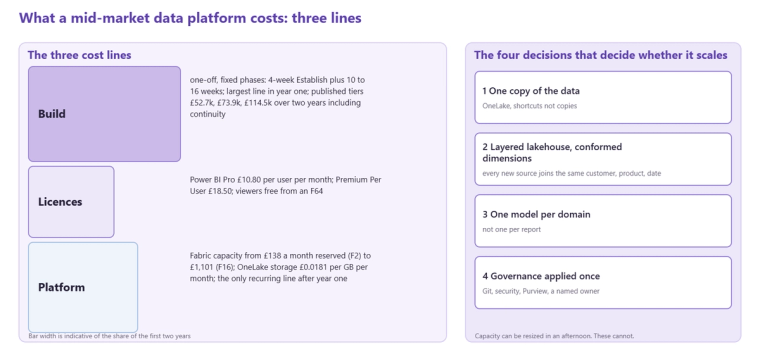
A data platform for a mid-sized business costs three lines: the platform itself, which on Microsoft Fabric is a capacity from £138 a month reserved for an F2 and £550 for an F8, with an F4 to F16 typical for a first platform, plus OneLake storage at £0.0181 per gigabyte per month; the licences, Power BI Pro at £10.80 per user per month for authors and viewers, with viewers free from an F64 at £4,404 a month; and the build, a four-week Establish phase and a ten to sixteen week build priced as fixed phases, which on our published Analytics Acceleration Programme tiers is an indicative two-year investment of £52.7k, £73.9k or £114.5k by business size, including continuity support. The build is the larger line in year one and the platform is the only recurring line after it. Whether it scales as the business grows is decided by four design choices made in the Establish phase, not by the capacity size, which can be changed in an afternoon. This post sets out the three cost lines with figures, the four decisions, and the ways a platform fails to scale.
Line one: the platform
Fabric is priced per capacity unit hour, £0.1585 in UK South pay as you go: an F2 is £231 a month pay as you go or £138 reserved for a year, an F4 £463 or £275, an F8 £926 or £550, an F16 £1,851 or £1,101, an F64 £7,405 or £4,404. Reserve the base, pay as you go for peaks, and pause what is not needed overnight. Storage is £0.0181 per gigabyte per month, so a terabyte is about £18. Compared with Databricks or Snowflake the licence is usually lower for a Microsoft estate because Power BI, governance and the data engineering share one meter; the build is similar on any platform. How much does Microsoft Fabric cost? has the full comparison and the Fabric licensing calculator sizes it for your estate.
Line two: the licences
Power BI Pro at £10.80 per user per month covers everyone who authors or views on a shared capacity below F64; Premium Per User at £18.50 is for larger models and paginated reports; from F64 viewers need no licence, which pays back at around 380 to 400 users. A business of 200 people with 150 report viewers is around £19,000 a year on Pro and would not reach the F64 break-even. Power BI and Fabric licensing explained covers the cases.
Line three: the build
Four weeks to establish definitions, sources, owners, security and architecture, then ten to sixteen weeks to land the ERP and the other systems, build the layered lakehouse and gold star schema, the certified semantic model and the priority reports, and close a month end on the platform. Priced as fixed phases rather than day rates. The published tiers include enablement and two years of continuity. What moves it is the number of source systems and domains, not the number of reports. What does a Power BI consulting engagement cost? breaks the tiers down and how long does a Fabric implementation take? the weeks.
The four decisions that decide whether it scales
First, one copy of the data: everything lands in OneLake once and every engine reads it, with shortcuts rather than copies for data that lives elsewhere, so adding a system adds a pipeline rather than a platform. Second, a layered lakehouse with conformed dimensions: bronze, silver and gold, with one customer, one product and one date dimension that every new source joins, so the tenth system is modelled the same way as the first. Third, one semantic model per domain on shared dimensions rather than one per report, so a hundred reports are a hundred thin layers rather than a hundred models to refresh. Fourth, governance applied once: Git and deployment pipelines, row-level and OneLake security, Purview, a named owner, so growth adds reports and users rather than exceptions. A platform that gets these four right scales by resizing the capacity; one that gets them wrong is rebuilt at year three. What does a modern data engineering architecture on Azure look like? describes the architecture and how do you build a single trusted analytics layer? the definitions work.
How platforms fail to scale
A model per report, so refreshes multiply and numbers drift. Data copied into every workspace that wants it. Transformation logic in Power Query inside each report rather than in the lakehouse. No source control, so a change breaks production. And no owner, so definitions drift until finance stops trusting the numbers. None of these is fixed by a bigger capacity. Why analytics projects rot is the longer diagnosis.
Where to start
Size the capacity last. Decide the four things first, in the Establish phase, and the capacity follows from the overnight load and the daytime query pattern, which for most first platforms is an F4 to F16. Our data platform and warehouse page describes the build, the Analytics Acceleration Programme publishes the tiers, and the free audit will tell you which of the four decisions your current estate has already got wrong.
Related reading
How much does Microsoft Fabric cost? UK prices compared with Databricks and Snowflake
What does a modern data engineering architecture on Azure look like?
How long does a Microsoft Fabric implementation take?
Data warehouse consultancy in the UK: what you are actually buying
James Morley
Analytics Solutions Consultant
Part of the Hopton Analytics team, delivering governed analytics programmes for UK mid-market organisations.