
Pyramid has a second name: ServiceNow ADA. What Autonomous Data Analytics is, what it adds to the Pyramid engine, and the two routes for a Pyramid estate.
ServiceNow Autonomous Data Analytics, which ServiceNow's own people and its customers already shorten to ServiceNow ADA, is the enterprise analytics product that ServiceNow built from Pyramid Analytics after completing the acquisition in March 2026: Pyramid's governed semantic layer, generative BI, root-cause analysis, scenario modelling and data science workbench, built natively into the ServiceNow AI Platform and extended so that it monitors KPIs, detects anomalies and triggers a workflow or an AI agent when a threshold is crossed. If you run Pyramid today, the product you bought has not gone anywhere: the standalone Pyramid Decision Intelligence Platform continues, with Newton as the current release, and the ServiceNow version is the same engine with a second name and a new home. Gartner now assesses the two together, placing ServiceNow, including Pyramid, furthest for Completeness of Vision in the 2026 Magic Quadrant for Analytics and BI Platforms and first across every use case in the 2026 Critical Capabilities report. This post explains what the new product is, what it adds, what has been resolved since our August post, and the two routes a Pyramid estate can take. We are Pyramid's UK Partner of the Year and a ServiceNow partner, so we deliver both.
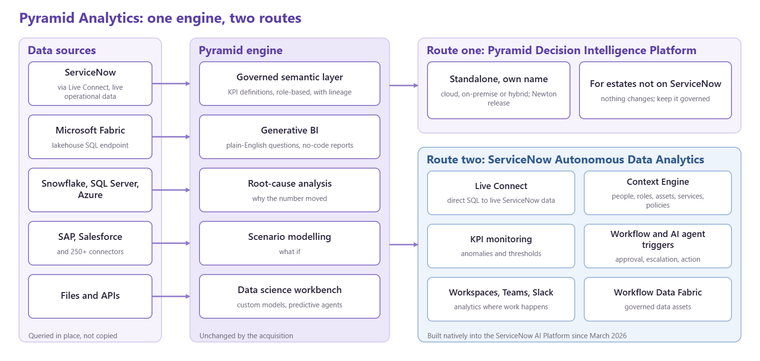
What is actually in it
ServiceNow's own description lists six capabilities. Autonomous analytics: KPIs are monitored, anomalies detected, and a workflow or an AI agent is triggered when a threshold is crossed, with a person approving or the agent acting within set limits. Root cause and prediction: the engine explains why a number moved using live, governed data and the business context held in ServiceNow's Context Engine, which maps people, roles, assets, services and policies. Self-service through the AI Data Explorer: plain-English questions and no-code reports and dashboards, which is Pyramid's generative BI. A governed semantic layer that queries external systems in place with role-based KPI definitions and lineage, which is Pyramid's semantic model. Analytics embedded in ServiceNow workspaces and workflows and in Microsoft Teams and Slack. And data science for professionals: custom models, predictive agents and the DSML workbench. Everything after the first item is Pyramid; the first item is what ServiceNow added, and it is the reason for the word autonomous. Pyramid Analytics is now part of ServiceNow: what it means if you run it today was written when none of this had a name.
What ServiceNow added around the engine
Three things. Live Connect, announced at Knowledge 2026 in May, gives the analytics engine a direct SQL path to live ServiceNow operational data, so tickets, assets, cases and HR records are analysed as they are rather than through an extract. Workflow Data Fabric and the Context Engine supply the business context and the governed data assets that the root-cause and prediction features reason over. And the ServiceNow workflow and AI agent layer is what turns an insight into an action: an approval, an escalation, a reorder, raised by the data rather than found in a dashboard. For a business that already runs ServiceNow, this is the significant part, because it closes the gap between seeing a number and doing something about it, which is the whole argument of decision intelligence.
What continues unchanged
The Pyramid Decision Intelligence Platform is still sold and supported under its own name, in cloud, on-premise and hybrid deployments, with the Newton release current and the 250-plus connectors intact. Pyramid's partner programme continues and we remain in it. An existing deployment keeps working, keeps being upgraded, and needs no migration to ServiceNow to stay supported. The questions our August post listed as unresolved, whether Pyramid stays separately branded, how fast the integration would land and what the product would be called, now have answers: both names, quickly, and Autonomous Data Analytics. What is still not public is long-term standalone pricing and packaging, which we will say plainly when it is.
The two routes for a Pyramid estate
Route one, stay standalone. If your organisation does not run ServiceNow, nothing changes except that the engine you use is now developed by a much larger company with a Gartner position to defend. The sensible work is the work that was always sensible: a governed semantic layer, certified datasets, documented definitions and an owner, so the deployment's value holds whichever way the roadmap bends. Route two, move into ServiceNow. If your operations, IT, HR or finance teams already live in ServiceNow, the case for surfacing Pyramid's analytics there as Autonomous Data Analytics is strong: the same models, now with Live Connect to operational data, anomaly triggers and actions in the workflow. The sequencing is the thing to get right: the semantic layer first, then the KPIs and thresholds that justify a trigger, then the workflows, then the decision rights for any agent. An AI agent needs decision rights, not just intelligence covers the last step.
Where Microsoft fits
Most of our Pyramid clients also run Microsoft Fabric and Power BI, and the two are not in competition for the same job. Fabric is the data platform: the lakehouse, the pipelines and the governed gold layer. Power BI is the reporting layer for the Microsoft estate. Pyramid, as Autonomous Data Analytics, is the layer that queries many sources in place, including a Fabric lakehouse through its SQL endpoint, and acts inside ServiceNow. A business can run all three on one set of definitions if the semantic layer is built once and shared, which is the point of what is a semantic model? and the reason we keep both practices in one team.
What to do now
If you run Pyramid: audit the deployment against the governed shape above, confirm your upgrade path to Newton, and decide whether ServiceNow is in your estate's future, because that decides the route. If you are evaluating: the product is stronger than it was in February, the roadmap is clearer, and the question is whether your organisation's centre of gravity is ServiceNow, Microsoft or both. Our Pyramid Analytics page describes how we deliver both routes, and the free audit will tell you which one your estate is set up for.
Related reading
Pyramid Analytics is now part of ServiceNow: what it means if you run it today
What the analytics consolidation wave means for your platform choices
What is decision intelligence, and how is it different from traditional BI?
An AI agent needs decision rights, not just intelligence
Simon Devine
Managing Director
Part of the Hopton Analytics team, delivering governed analytics programmes for UK mid-market organisations.