
Claude Fable 5.2 reached Microsoft Copilot within days of release, and each Copilot app now offers a different list of models. Why a model change matters, what changes on 9 December for Irish and UK tenants, and a simple routine to keep Copilot's answers steady.
Anthropic released Claude Fable 5.2 on Monday. By Wednesday it was turning up in Microsoft Copilot. New models now reach Copilot within days of release, from OpenAI, Anthropic and xAI, with Mistral also available in Copilot Studio. That's good news. It also means the model doing your work can change while nobody is looking.
Nick DeCourcy, who works on Copilot adoption, mapped which models each Copilot app offered on 13 November. The spread is wide. Copilot Chat listed 6, Cowork 7, Copilot Code 11 when run locally and 7 in a cloud session, and Copilot Studio 20. When Fable 5.2 arrived, Cowork dropped Fable 5.1 straight away, while Copilot Studio still offers 5.1 alongside Fable 5.
For a business, the question isn't which model is best this week. It's whether the work Copilot does for you still comes out right after the model changes, and whether anyone has decided which models you allow.
Which AI models are in Microsoft Copilot?
Copilot now runs on several model families: OpenAI's GPT models, Anthropic's Claude models (Fable, Opus, Sonnet and Haiku), xAI's Grok, and Mistral in Copilot Studio. The list isn't the same in every app. Copilot Studio offers the most, because people build agents there and need to choose. Copilot Chat offers the fewest, and leans on an Auto option that picks for you.
Admins can narrow the list further. What one person sees depends on the app, the licence, the tenant's settings and the region. That's why two people in the same business can give different answers to "which model are we using?".
Why does a model change matter?
Model improvement isn't even. A newer model is usually better on average and sometimes worse at the specific thing you relied on. When OpenAI replaced GPT-4o with GPT-5 in ChatGPT in August 2025, the backlash brought 4o back within days. Plenty of people agreed GPT-5 was more capable and still missed how 4o handled their work.
Nick puts it well with a people analogy. Hand a task Sarah does every week to Michael and it will probably still get done, just differently. If you think of the assistant as a member of the team, you'd check Michael has the task in hand before leaving him to it. If you think of it as software, changing a component means testing before it goes back to work. Either way, the check is the same.
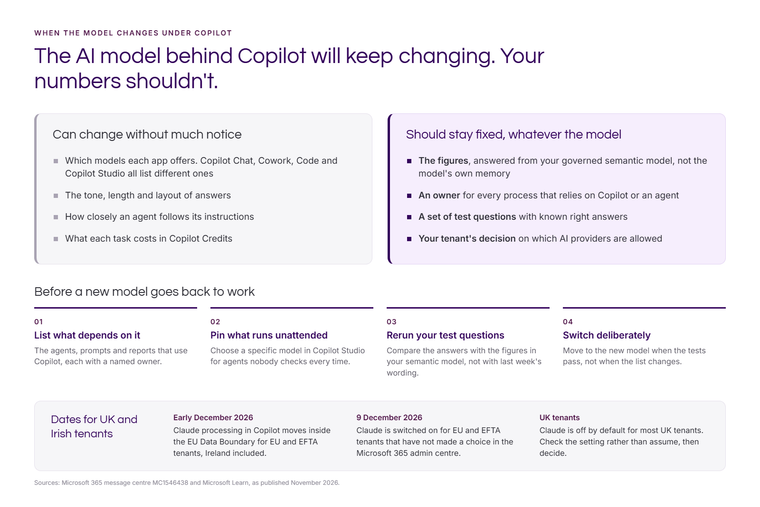
What changes with a new model is rarely obvious. It's the tone, length and layout of answers, how closely an agent follows its instructions, how it handles a question it can't answer, and what each task costs in Copilot Credits. None of that shows up as an error. It shows up as a report pack laid out differently, a summary that drops the caveat, or an agent that starts answering questions it used to refuse.
What changes on 9 December for Irish and UK tenants?
Until now, Claude models in Copilot have sat outside the EU Data Boundary, so most EU, EFTA and UK organisations have had them switched off by default. That's changing. Microsoft's message centre post MC1546438 says processing for Claude models in Copilot moves inside the EU Data Boundary in early December 2026, and that on 9 December Microsoft will switch Claude on for EU and EFTA tenants that haven't made a selection.
For businesses in Ireland, that means Claude appears in Copilot on 9 December unless someone has chosen otherwise. For UK businesses, Claude is off by default in most tenants, and the December change in that post covers EU and EFTA only. Either way, it's a decision worth making on purpose rather than by default.
The setting is in the Microsoft 365 admin centre under Copilot, then Settings, then AI providers operating as Microsoft subprocessors, and it needs an AI Administrator or Global Administrator. The choices are no users, specific users and groups, or all users. Copilot Studio and Power Platform have their own controls in the Power Platform admin centre once the Microsoft 365 setting allows Claude. If you're weighing up the data protection side, our guide to AI, your data and UK data protection covers what a leader needs to get right.
Where the answer comes from matters more than which model writes it
This is where most of the risk sits, and it's in your control. If Copilot or an agent works a figure out from whatever it can find, a model change can change the figure. If it answers from a governed semantic model, the figure is the same whichever model phrases it. The model changes the wording. The number comes from the data.
That's why the work that makes AI dependable in a business is mostly data work: one agreed definition of revenue, margin or stock, held in a semantic model everyone uses, with security that matches who should see what. Copilot in Power BI, Microsoft Fabric data agents and Copilot Studio agents can all answer from that model. When they do, swapping Fable 5.1 for 5.2, or GPT-5.6 for GPT-6.1, becomes a question of style, not of trust. A finance director can sign off a number that AI produced when they know where it came from.
A simple routine for model changes
You don't need a committee. You need a short routine that someone owns.
- List what depends on it. The agents, saved prompts and reports that use Copilot, each with a named owner.
- Pin what runs unattended. In Copilot Studio you can choose a specific model instead of Auto. Do that for any agent that runs without a person checking every answer. Our post on Copilot Studio Auto or a pinned model covers the trade-off.
- Keep a set of test questions. 10 to 20 real business questions with known right answers, taken from your reports. Include a couple the agent should refuse.
- Rerun them when the model changes. Compare the answers with the figures in your semantic model, not with last week's wording.
- Switch deliberately. Move to the new model when the tests pass, not when the list changes.
- Decide your tenant policy. Which AI providers you allow, for whom, and who reviews it when Microsoft adds a new one.
Is it confusing?
Yes, a bit. Different models in different apps, versions that disappear from one place and stay in another, and region rules that differ between Dublin and Leeds. Microsoft has done a good job of making Copilot work across vendors. The price of that choice is that someone in your business needs to own it.
The model will keep changing. Your numbers shouldn't.
If you want Copilot answering from figures you already trust, our Microsoft AI and Copilot work starts with the data, not the model. You can check where you stand with the AI data readiness checker, or ask us for a free data assessment.
Sources: Nick DeCourcy's model comparison on LinkedIn, 13 November 2026; Microsoft 365 message centre MC1546438; Microsoft Learn: Anthropic models in Microsoft Online Services, and Copilot in Microsoft 365 apps with Anthropic models.
Related reading
- Copilot Studio Auto or a pinned model? What the GPT-5 Auto retirement means
- Can a CFO sign off a number that AI produced? Let the AI propose, let the model calculate, and keep the proof
- AI, your data and UK data protection: what a leader needs to get right
- What a semantic layer is, and why AI needs one
- The real risk with AI isn't the model. It's how you use it.
Simon Devine
Managing Director
Part of the Hopton Analytics team, delivering governed analytics programmes for UK mid-market organisations.