
The number Microsoft put on stage at FabCon Europe 2026 was blunt: most AI projects fail, and they fail for data reasons. Here is a practical checklist for working out whether your estate is ready before you commission a proof of concept.
Around 85% of AI projects fail. It is one of the most quoted figures in the industry, and the useful part is not the number itself but the reason behind it. They do not fail because somebody picked the wrong model. They fail because of poor data quality, missing business context, or an architecture that could not scale beyond the demo. The model is usually the last thing to go wrong, and by then the project was already lost.
That was the thread running through FabCon Europe 2026, and it matches what we see. Hopton delivers Microsoft Fabric and analytics projects for mid-market organisations across retail, healthcare, construction and professional services, and the AI conversations that stall are almost never stalled by the AI. They are stalled by the estate underneath it.
So rather than restate the keynote, this post sets out what a data estate actually needs to look like before AI is worth adding, and gives you a checklist you can run against your own organisation this week.
Three failure modes, and why they are all data problems
- Poor data quality. An AI assistant answering questions over your sales data will confidently repeat every duplicate customer record, every miscoded transaction and every stale price list it finds. People forgive a dashboard with a known quirk, because a human is reading it and applying judgement. They do not forgive an AI that states the wrong number fluently.
- Missing business context. Your data can be clean and still mean nothing to a model. If revenue is calculated three different ways in three departments, if "active customer" has no agreed definition, if the logic that turns transactions into margin lives in one analyst's head, an AI has nothing reliable to reason over.
- Scaling limitations. A proof of concept over one workspace, one dataset and one enthusiastic champion proves very little about production. Production means security boundaries, refresh schedules, capacity under contention and a support model.
Context is not documentation for its own sake. It is semantic models, agreed measures and ownership, which is why we treat AI-ready data foundations as a discipline in its own right rather than a phase of an AI project.
Unification and activation have to happen in parallel
The traditional advice was sequential: spend a year or two unifying your data, then add AI at the end as a reward. That ordering no longer works. Wait for a perfect estate and you will wait forever, and the organisation will lose patience long before you finish. Activate AI with no unification and you get the failure modes above.
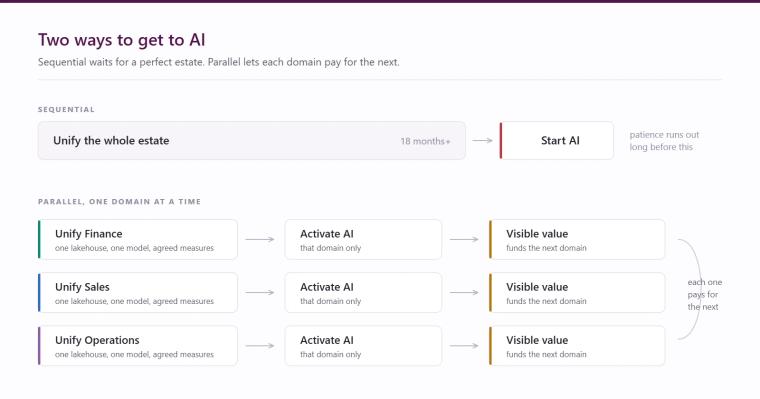
The practical approach is to run both on a narrow front. Pick one domain, usually finance or sales, where the data is closest to ready. Unify it properly: one lakehouse, one semantic model, agreed definitions. Then activate AI on that domain only, and let the visible value fund the next. This is the shape of most successful Fabric programmes we deliver, and it is why we structure delivery in fixed, outcome-based phases rather than open-ended transformation.
Governance is a prerequisite, not an afterthought
AI surfaces whatever is in the data. That sounds obvious until you apply it to your own estate. Every spreadsheet dropped on a shared drive, every export with personal data in it, every report built on a source nobody owns: an assistant with broad access will find all of it and answer questions from it.
Which is why sensitivity labels, access controls and row-level security stop being compliance chores and become load-bearing. Before enabling Copilot or any conversational tool, you need to answer three questions:
- Who can see each dataset, specifically, and is that written down anywhere?
- Does the AI inherit those boundaries automatically, or is it relying on the audience being controlled?
- Who is accountable when the answer to either question is "not sure"?
In Fabric the controls exist. Object-level and row-level security carry through to Copilot and agent access, and sensitivity labels follow the data. But they only protect you if they were applied before the AI arrived, which makes this a data governance exercise rather than an AI one.
The readiness checklist
Here is the checklist we run with clients before any AI proof of concept is commissioned. Score yourself honestly.
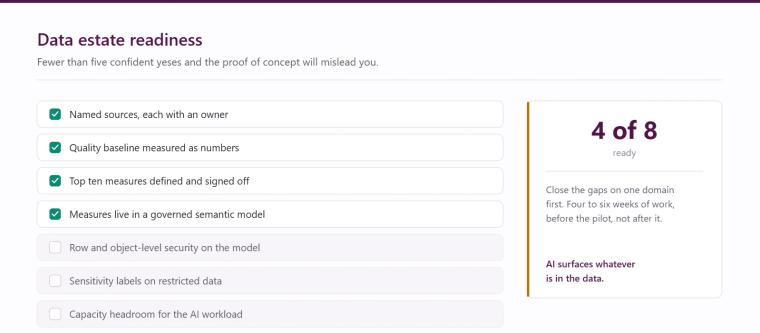
- Named sources. You can list the systems holding your critical data, and each has a named owner.
- Quality baseline. For the domain in scope you know the duplicate rate, the completeness of key fields and the freshness of the data as numbers, not impressions.
- Agreed definitions. The top ten measures the business runs on have one definition each, written down and signed off.
- A semantic model. Those measures live in a governed model, not in individual report files.
- Security that transfers. Row-level and object-level security are defined on the model, so any AI access inherits them.
- Sensitivity labels. Data that should not surface in an AI answer is labelled, and policies act on those labels.
- Capacity headroom. You know current utilisation and what the AI workload will add, before it lands on the same capacity as month-end reporting.
- An owner for the answer. When the AI is wrong, somebody specific traces it and fixes the data.
Fewer than five confident yeses means the proof of concept will mislead you. The honest move is to spend four to six weeks closing the gaps on one domain first. Our AI data readiness checker walks through a structured version of this, and the free data estate audit does it with you.
The gaps that undermine projects silently
A checklist catches the state of the estate today. What kills AI projects six months in is drift. A source system changes a field. A pipeline starts silently dropping rows. A measure gets redefined in one report but not the model. Nothing fails loudly, and the AI keeps answering, now slightly wrong.
This is why we treat monitoring as part of AI readiness rather than an operations afterthought. Through our Analytics Acceleration Programme the estates we look after are monitored continuously for refresh failures, volume anomalies, model changes and capacity pressure. Most of what we catch would never have raised a ticket, because nothing visibly broke. That quiet assurance is the difference between an AI feature that still has credibility in month twelve and one that was switched off in month four.
Where to start
If AI investment is on your roadmap for 2027, the highest-value work this quarter is not model selection. It is an honest readiness assessment of one business domain, a governed semantic model over it, and the security and monitoring to keep it trustworthy. That foundation makes every AI feature you add afterwards cheaper, faster and safer.
We are a Microsoft Solutions Partner and this is the work we do every week. If you would like a view on your own estate, talk to us or start with the free audit. The model can wait. The data cannot.
Simon Devine
Managing Director
Part of the Hopton Analytics team, delivering governed analytics programmes for UK mid-market organisations.