
Platform Analytics, Workflow Data Fabric, RaptorDB, the Context Engine, ADA and AI Control Tower: what each does, and the order customers adopt them.
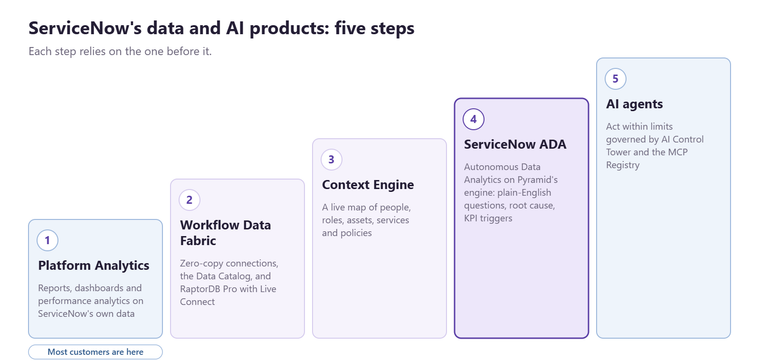
ServiceNow's data and AI products fit together as five steps on what ServiceNow calls its real-time data foundation, launched at Knowledge 2026 in May. Platform Analytics is the reporting built into every instance. Workflow Data Fabric connects data from outside ServiceNow without copying it, with the ServiceNow Data Catalog for discovery and lineage and RaptorDB Pro, whose Live Connect gives analytics direct SQL access to live operational data. The Context Engine keeps a continuously updated map of people, roles, assets, services and policies. ServiceNow ADA (Autonomous Data Analytics), built on Pyramid Analytics' engine after ServiceNow completed that acquisition in March 2026, answers plain-English questions across ServiceNow and external data, explains why a number moved and raises a decision when a threshold is crossed. And AI agents act on those decisions within limits governed by AI Control Tower. Each step relies on the one before it, and most ServiceNow customers today are on the first with some of the second. We are Pyramid's UK Partner of the Year and a ServiceNow partner, and this post sets out what each step does, what it needs underneath, and where to start.
Step one: Platform Analytics
Platform Analytics is the reporting, dashboards and performance analytics built into every ServiceNow instance. It is the right home for operational reporting on ServiceNow's own data: incident and request volumes, SLA performance, backlog and trend. It answers what happened inside ServiceNow. It rarely answers why, it does not reach far beyond ServiceNow's tables, and nothing happens automatically when a number turns red. For many organisations that is enough, and the first piece of work is making the existing dashboards trusted rather than adding more of them.
Step two: Workflow Data Fabric
Workflow Data Fabric brings the rest of the business in. Zero-copy connections reach ERP, HR, finance and data platforms without duplicating the data, and the ServiceNow Data Catalog, built on the data.world acquisition, adds automated discovery, lineage and a shared business glossary. RaptorDB Pro is the platform's own database, now handling operational and analytical workloads together: Live Connect gives analytics providers direct SQL access to live operational data with no pipeline, Live Perform scales analytical processing, and Live Archive lets historical and live data be queried together. ServiceNow Otto, the natural language assistant within Workflow Data Fabric, helps teams build curated, governed data assets step by step. This is the step where the catalogue and the ownership of each data asset matter more than the connectors.
Step three: the Context Engine
The Context Engine is a continuously updated map of the business: people, roles, assets, services and policies, and how they relate. It is what lets an answer know who owns a service, which customers a failing asset affects, or which policy applies to a request. Root-cause analysis and agent decisions both lean on it, because an anomaly without context is just a number that moved.
Step four: ServiceNow ADA (Autonomous Data Analytics)
ADA is Pyramid's decision intelligence engine built natively into the ServiceNow AI Platform: a governed semantic layer, plain-English generative BI, root-cause analysis, scenario modelling and a data science workbench, with KPI monitoring that raises a decision in the workspace, Teams or Slack when a threshold is crossed. It queries ServiceNow and external data together, so the analysis spans the estate rather than one system. Autonomous Data Governance, announced alongside it, adds quality, observability and policy checks on the data underneath. Gartner placed ServiceNow, including Pyramid, furthest for Completeness of Vision in the 2026 Magic Quadrant for Analytics and BI Platforms and first across every use case in the 2026 Critical Capabilities report. What is ServiceNow ADA? covers it in full.
Step five: AI agents, governed by AI Control Tower
The decision ADA raises goes to a person, or to an agent that acts within set limits. AI Control Tower is where an organisation governs its AI: which agents exist, what they may do, and what they did. The ServiceNow MCP Registry, a private registry of approved MCP servers governed through AI Control Tower, controls which tools agents can reach, and the AI Gateway adds controls and observability for agent workloads that run on third-party AI. Agents are the last step, not the first, because an agent acting on an undefined measure or an unowned threshold makes the wrong decision faster. An AI agent needs decision rights, not just intelligence sets out what to write down before one acts.
Where most customers are, and what each step needs
Most ServiceNow customers run step one and have started step two with a handful of connections. The order matters because each step needs something from the one before. Step two needs trusted definitions from step one, or the external data simply adds more numbers nobody agrees on. Step three needs named owners for the data assets catalogued in step two. Step four needs the definitions, the owners and the context, so that a plain-English answer is the right answer and a threshold means something. Step five needs thresholds and decision rights that a person has signed. Skipping a step is possible on paper and expensive in practice. For an organisation that also runs Microsoft, Microsoft Fabric remains the data platform and Power BI the Microsoft reporting layer; ADA reads across them and acts inside ServiceNow, and both should share one set of definitions. Pyramid and Power BI side by side explains how the two fit.
Where we help
We work on steps one to four and on the hand-off into step five: making Platform Analytics reporting trusted, moving the questions that outgrow it into ADA, connecting the data that lives outside ServiceNow, often in a Microsoft Fabric estate, building the semantic layer and the definitions, and setting the thresholds and decision rights before any agent acts. Most deployments take four to six months. If you already run Pyramid, most of the engine work is done; Pyramid Analytics is now part of ServiceNow explains what changes. Our Pyramid Analytics and ServiceNow ADA page describes how we deliver, and the free audit will tell you which step your estate is really on.
Related reading
What is ServiceNow Autonomous Data Analytics (ADA), and what does it mean if you run Pyramid?
Pyramid Analytics is now part of ServiceNow: what it means if you run it today
An AI agent needs decision rights, not just intelligence
Pyramid and Power BI side by side: two strong platforms, different fits
Simon Devine
Managing Director
Part of the Hopton Analytics team, delivering governed analytics programmes for UK mid-market organisations.