
Conversational analytics has quietly become a realistic proposition for any organisation with a Power BI semantic model and a Copilot licence. The cost is lower than most people assume. The readiness bar is higher.
Conversational analytics has been promised for a decade and has mostly disappointed, because the thing answering the question never understood the business. Fabric IQ reaching general availability is the point at which that changes for organisations already invested in Power BI, and the reason is unglamorous: it answers from your semantic model rather than guessing at raw tables.
This post sets out what Fabric IQ actually is, how it connects, what it costs, how security behaves, and what has to be true about your semantic model before the answers can be trusted. The last part is where most of the work is.
What Fabric IQ is, in practical terms
Fabric IQ is generally available and grounds AI answers in your governed Power BI content. In Copilot Chat and in Cowork, Copilot selects the relevant report or semantic model and answers from it, rather than from a general model's impression of your data. Fabric data agents in Copilot Studio are also GA, which gives a supported route into Teams and Microsoft 365 Copilot.
Alongside this, the Fabric IQ MCP server is generally available. MCP is an open protocol for connecting AI agents to data and tools, and the practical consequence is that your semantic model becomes an endpoint any agent can query: Microsoft Copilot, GitHub Copilot, a development environment such as VS Code, or a custom agent you build.
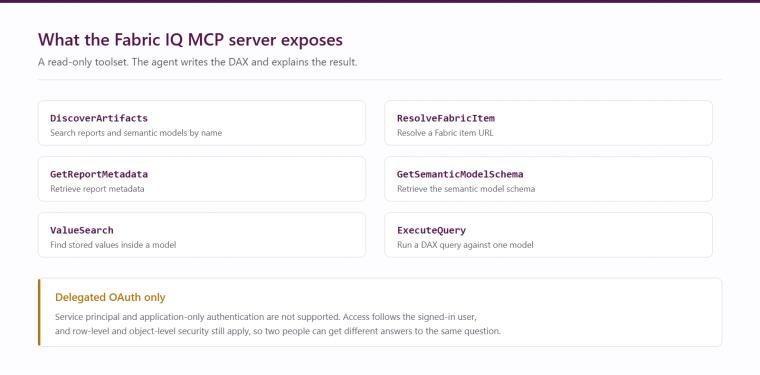
It is worth being precise about what that endpoint does, because "conversational analytics" implies something more magical than what is actually happening. The server exposes six tools: DiscoverArtifacts to search reports and models by name, ResolveFabricItem to resolve a Fabric item URL, GetReportMetadata, GetSemanticModelSchema, ValueSearch to find stored values inside a model, and ExecuteQuery to run DAX against one model. There is no "answer this question" tool. The agent chooses and combines the tools, writes the query, and interprets what comes back.
Microsoft 365 Copilot inside Power BI is separately at preview, off by default, and requires an M365 Copilot licence, so that specific experience is its own decision.
The strategic point is that the semantic model stops being something only Power BI consumes. It becomes the governed interface through which anything, human or agent, asks the business a question.
The cost is lower than people assume
The most common objection we hear is budgetary, because everyone has been conditioned to expect AI features to carry heavy per-token costs. Fabric IQ in Copilot Chat and Cowork comes without additional AI token costs, and querying a semantic model is closer in cost to a standard analytical query than to heavy AI compute.
That changes the sizing question. You are not building a business case for a large new AI spend. You are asking whether your existing capacity can absorb some additional query load, which is the same question you already ask about any new report audience. If capacity headroom is the concern, that is a Fabric capacity conversation rather than an AI one.
The costs that do bite are the ones nobody budgets for: the time spent fixing a semantic model that was never built to be queried this way, and the credibility lost if you skip that step.
Security carries over, and that is the point
The reasonable fear about conversational analytics is that it becomes a side door around your access controls. It does not, provided the controls were defined properly in the first place.
- Object-level and row-level security defined on the semantic model are enforced automatically through Copilot, Cowork, data agents and MCP access. Two people can get different answers to the same question, which is correct.
- Sensitivity labels and DLP policies apply across chat and export.
- The MCP server uses delegated OAuth through Microsoft Entra ID and requires the delegated Power BI Service permissions Item.Read.All, Item.Execute.All and Dataset.Read.All. Service-principal and application-only authentication are not supported, and there is no administrator-impersonation path, so access always follows the signed-in user.
There are two controls worth setting deliberately rather than discovering later. A per-semantic-model setting, managed by users with write permission on the model, governs whether read-only users can reach that model through Copilot, Cowork, data agents and MCP servers, and it is enabled by default. Above it sits an admin-level restriction from Copilot. Both are worth reviewing on models containing commercially sensitive data.
The honest implication is that enabling Fabric IQ is an audit of your existing security model. If row-level security on your estate is incomplete, inconsistent, or applied in reports rather than the model, conversational access will expose that rather than cause it. Uncomfortable, and better found now.
What the semantic model needs before you turn this on
This determines whether conversational analytics is impressive or embarrassing, and it has nothing to do with AI.
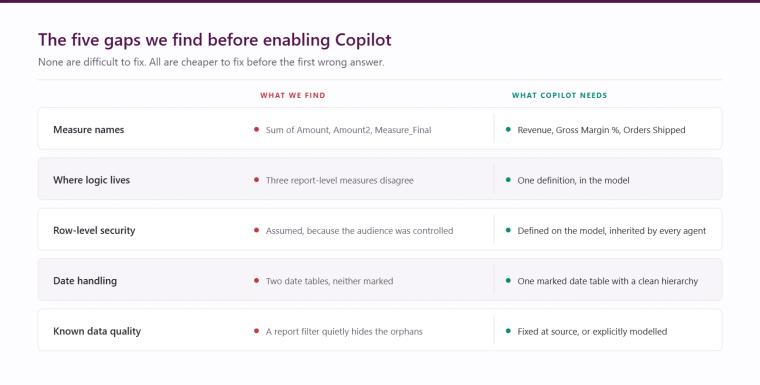
- Measures need real names. A model containing Sum of Amount, Amount2 and Measure_Final produces answers that are technically correct and practically useless, because nothing tells the agent which represents revenue. Every measure a business user might ask about needs a name a business user would recognise, and ideally a description.
- Relationships need to be clear and correct. Ambiguous paths, inactive relationships relied on through DAX, and many-to-many joins added to make one visual work all degrade the reliability of generated queries. A human developer learns a model's quirks and works around them. An agent takes the model at face value.
- Business logic needs to be consistent and in one place. If revenue is defined one way in the model and another way in three report-level measures, the answer depends on what gets picked. Conversational analytics rewards estates that agreed their definitions and punishes those that did not, which is the same data governance discipline that makes dashboards trustworthy.
- Data quality needs resolving rather than working around. Duplicate customers, orphaned keys and unmapped codes that a report quietly filters out will surface in an AI answer, because nobody told the agent about the unwritten rule.
- Date handling needs to be properly modelled. A marked date table with a clean hierarchy is what lets "how did last quarter compare with the same quarter last year" resolve correctly. Without it, time intelligence questions fail in ways that are hard to explain.
Knowing the limits
A few constraints are worth setting expectations against before anyone demos this to a board:
- Reports and semantic models are supported. Dashboards, paginated reports, apps, ontologies and data agents are not.
- Each query targets one semantic model, and results default to 250 rows unless the caller asks for more. Large results may come back as CSV and may be truncated.
- Answers are only as current as the model's last successful refresh, so a conversational answer inherits every refresh problem the estate already has.
- It is not available in Power BI-only regions or sovereign clouds.
Where to start
Pick the one semantic model in best shape serving a well-defined audience, usually finance or sales. Review it against the five gaps above. Fix what you find, set the access controls deliberately rather than by default, and enable Fabric IQ for that model and that audience only. Let it earn trust in one domain before widening.
The organisations that get value from conversational analytics in 2027 will not be the ones that enabled it first. They will be the ones whose semantic models were worth asking.
Hopton is a Microsoft Solutions Partner building governed Fabric and Power BI estates for organisations across the UK and Ireland. Our AI and analytics and Microsoft AI and Copilot pages cover how we approach this work, and the AI data readiness checker is a quick way to gauge where you stand. If you would like a semantic model reviewed properly, talk to us or start with a free audit.
Related reading
Kiran Sahiba
Analytics Solutions Consultant
Part of the Hopton Analytics team, delivering governed analytics programmes for UK mid-market organisations.